Let's not fall into their colonial trap.
History has taught us that settlement colonialism is a recognised and successful British strategy.
I was at a loss as to how we could ever win an independence referendum when one-third of our population is made up of English immigrants, the majority of whom, not all, will always vote for British rule. Therefore, this can never be accepted as a democratic referendum.
However, there are other ways to declare independence, including a Unilateral Declaration of Independence (UDI), as one of our followers suggested. A UDI is when a territory declares itself independent without the consent of the state it’s breaking away from. It is a political act declaring “We are now a sovereign state, and we’re not asking permission.” This usually happens when the parent state refuses a referendum or constitutional path. What's worth remembering is that international law does not explicitly forbid UDIs.
If a UDI were triggered in Cymru, England would immediately declare it illegal and unconstitutional, but other nations would recognise the new state.
Examples of successful UDIs are the USA in 1776, Bangladesh in 1971 and Kosovo in 2008, so it can be done. In 1919, Ireland's Dáil declared independence unilaterally and eventually got recognition. The First Serious Welsh UDI Proposal came from Gwynfor Evans (1980–81), but no Welsh political party or government has ever formally pursued or prepared for a UDI.
Gweriniaeth Cymru / Republic of Wales will openly discuss UDI as a necessary tool because Cymru has a large English-born population that will affect any independence referendum. Given the demographics, it would be foolish to accept such a referendum; we would be setting ourselves up to fail. Let's not fall into their trap.
Other nations have proved that a UDI works, and with strong domestic support, dogged determination and international backing, it could work for Cymru too. It's a vision worth pursuing.
Up the Republic!
Feeding a monster that will devour you is madness.
The UK presents itself as a voluntary union of equal nations. But in practice, it is a centralised state dominated by England. Attendance by Scottish/Welsh nationalists helps maintain the illusion of equality.
The union is not voluntary, and English-majority interests routinely override the priorities of Celtic nations. This is not a flaw; it is the design. Westminster is a majoritarian system built around England's political weight.
Participation sends a contradictory message and weakens the independence narrative; non‑attendance is a clearer, more coherent political signal: We do not accept Westminster’s authority and seek to build our own democratic institutions.
Conclusion.
If you agree with the above, then you must conclude that those nationalist MPs attending Westminster have abandoned their principles in exchange purely for personal financial gain and prestige.
Welsh and Scottish nationalists should not be playing Westminster's unwinnable game.
---------------------------------
For thirty pieces of silver.
Most of us will agree that Westminster offers Welsh nationalists little beyond a symbolic presence, and here's the reason why.
Plaid Cymru currently has 4 MPs in the House of Commons, representing Welsh nationalists' aspirations in Westminster. 7 Sinn Féin MPs abstain (they do not take their seats), SNP has 8 seats, the Speaker and 3 Deputy Speakers do not vote, so, out of 639 voting MPs, only 12 are Welsh and Scottish nationalists, the majority of the remaining will be imperial British nationalists who maintain the unity of the British union at all costs.
Heavily outnumbered, nationalist MPs will get very little from Westminster apart from scraps from the table to keep them onside, and, of course, their salary plus expenses. If these parties are sincere about independence, why would they want to play Westminster's unwinnable game? For the reasons given, we can conclude that it is only for financial gain and for what they see as prestige.
To be taken seriously, we must follow Sinn Féin's lead and avoid Westminster's trap.
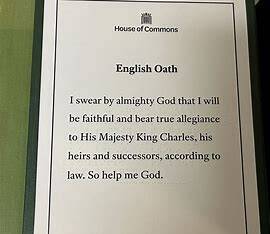
What does abstention mean for an MP? It means that they do not take the oath to the monarch and do not attend Parliament's sittings or committees. They cannot vote in debates. They can still pursue cases on behalf of their constituents and represent them individually to Westminster on individual issues. They can have an office and staff to manage their cases and draw staff salaries. But the MP gets no salary unless they take the oath and attend Parliament.
Here in Cymru, nationalists need to consider resetting their minds. We need politicians to represent us with principles, not, as some would consider, career grifters. We need representatives who are genuine to the cause. There is no need to tread the same old path to London to swear an oath to England’s king in return for 30 pieces of silver.
If Independence is truly the aim, we need to see the light, sever the link to the Westminster trap, and walk away. Let’s be under no illusion that abstentionism will mean being brave, but it’s necessary if we want to break the chain and get off the endless unionist merry-go-round.
It’s something that should be seriously considered with or without Plaid Cymru.
Gwlad (Nation), a smaller Welsh nationalist party, doesn’t contest Westminster elections because the system offers them no realistic route to representation. They argue that a pro‑independence party contesting Westminster can feel contradictory. The reason is that Westminster is an English‑dominated institution; Welsh politics should be fought in Welsh institutions, and standing in Westminster elections reinforces the legitimacy of a parliament they ultimately want Wales to exit.
Many will say they have a legitimate point.